20 CPD-assessed e-learning courses for staff at FCA-regulated and MLR-registered firms, from AML and the Conduct Rules to SMCR and non-financial misconduct (NFM). Rewritten this year, and scheduled, chased and certified for you in the Fundsure Portal. £120 per person per year plus VAT for every course.
Two courses are a requirement for almost every firm, every year. The rest of the catalogue is what adequate procedures look like in practice.
The Money Laundering Regulations 2017 require firms to give relevant staff regular training (regulation 24). The FCA and JMLSG expect it refreshed at least annually.
Under SM&CR a firm must tell staff which Conduct Rules apply to them and take reasonable steps to make sure they understand them (FSMA section 64B).
Every firm must keep its staff competent for their roles (SYSC 5).
Bribery, tax evasion, sanctions, data protection and the rest turn on the firm having adequate procedures, and training is part of what that means to a regulator or a court.
Not sure which courses your firm needs? Read our guide to the training an FCA firm must give its staff
Nobody learns anything from sitting an identical course every year, and they notice. Every course carries the year of its edition, and each one is rewritten as the rules move. This year that meant all 20: 7 written from scratch and the rest rewritten, with the changes listed against each course below.
Each is about 45 minutes, built on workplace scenarios rather than generic e-learning, with a short test and a named certificate. Catalogue last updated September 2026.

Every course is assessed by the CPD Certification Service, and every certificate carries the CPD mark.
The courses most firms give every member of staff, every year.
Recognising and responding to money laundering and terrorist financing: due diligence, suspicious activity reporting and personal responsibilities. Aligned to JMLSG and FCA guidance, including Annex 1 firms. Available on its own for MLR-registered firms at £60 per person per year plus VAT.
The individual Conduct Rules that apply to nearly everyone in an SM&CR firm, and the senior manager rules above them, including fair treatment of customers and the Consumer Duty rule on good outcomes.
Bribery as it actually turns up: agents and intermediaries, facilitation payments, gifts and hospitality, and how to raise a concern.
How a firm can be prosecuted for somebody acting for it helping another cheat the tax system, and what a request to facilitate evasion looks like.
Sanctions are prohibitions, not risk ratings: what they prohibit, why an unlisted counterparty can still be caught, and why the transaction stops first.
The attacks that reach regulated firms through people: the convincing email, the familiar voice on the phone, the changed payment details.
UK data protection as it applies to a regulated firm, including what the Data (Use and Access) Act 2025 changed and what it did not.
What a reportable concern really is, the parts of the FCA's regime that reach a smaller firm, and the protection an individual has.
Non-financial misconduct (NFM): bullying, harassment and violence under the Conduct Rules, which reach firms outside banking from 01-Sept-26.
Market abuse: insider dealing, unlawful disclosure and market manipulation for everyone, not only people who trade: how ordinary conduct goes wrong.
The induction course: who the FCA is, how permissions decide what the firm may do, and how to find and read a rule.
For the people whose roles the specific rules are written for.
What makes a post, slide or email a financial promotion, the fair, clear and not misleading standard, and who may approve one.
For advisers making personal recommendations and discretionary managers deciding for individual clients.
Built around the moment a complaint is missed, not the process after it is logged: the definition clause by clause.
For investment firms and fund managers: what the firm may do with a fund, and what it must hold and be able to prove about its own survival.
How a regulated firm keeps its important services running when a supplier or system fails, and why that is a different question from business continuity.
For the people answerable for the firm.
Who is answerable for what, what certification means, what fitness and propriety is assessed against, and what you must disclose.
What being a director of a small or medium regulated firm actually requires, and how a decision is examined afterwards.
Running the compliance function: the risk assessment, a monitoring plan that finds things, board MI, breaches and personal accountability.
For HMRC-supervised firms.
Anti-money laundering obligations under the Money Laundering Regulations 2017 for everyone in a TCSP, with HMRC's supervision expectations.
The courses are half of it. The other half is not having to chase anybody.
Set each course once for the whole firm or a group, and it comes round every year on its date. New joiners are caught up automatically.
Reminders go out before each deadline, and the compliance officer gets a Monday email of who is behind.
A named certificate with the CPD mark for every pass, with a code that confirms it online - for a supervisor, an auditor or a new employer.
Every sitting, score and certificate, exportable to Excel and carried into the quarterly report to your board.
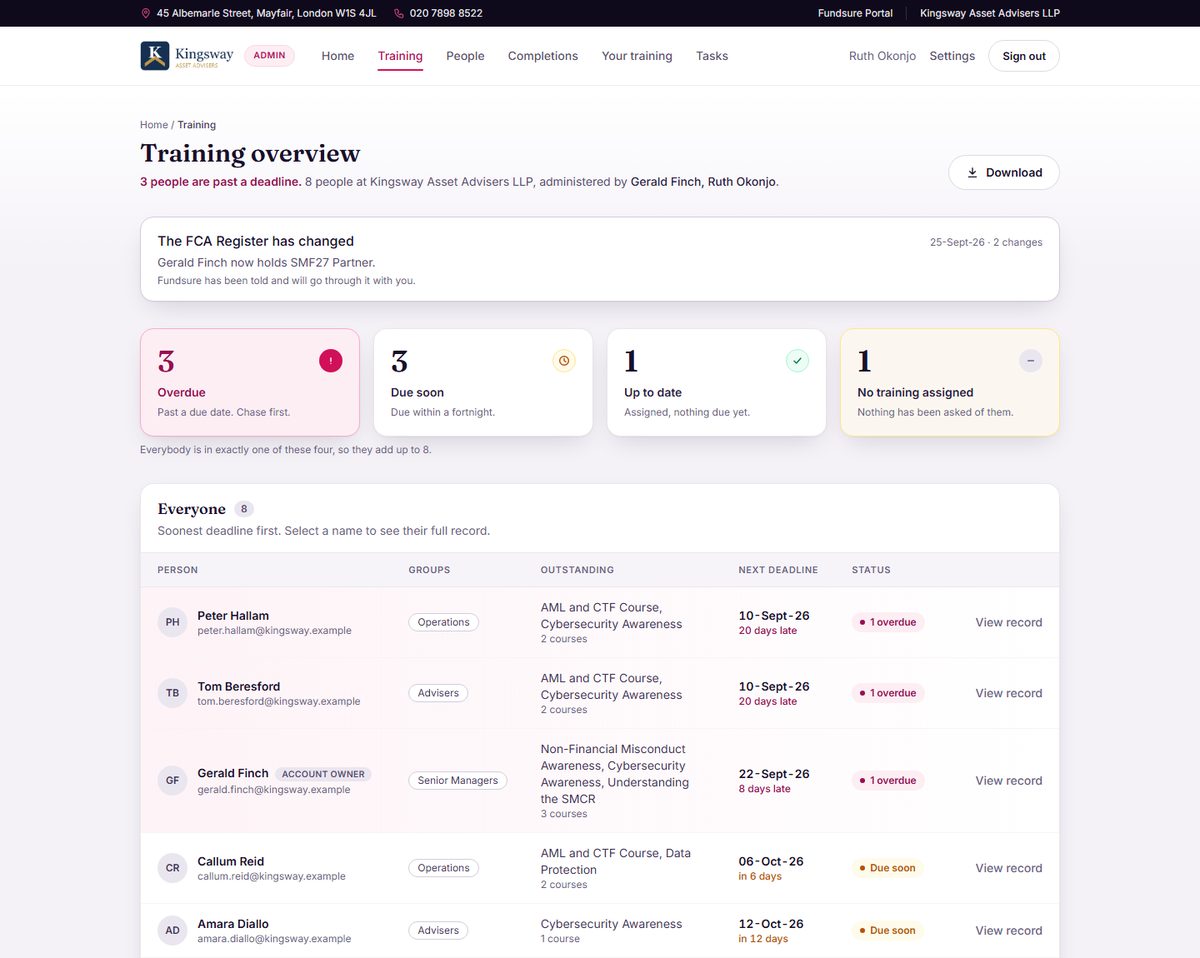
The compliance officer's view: who is overdue, who is due soon, and who has nothing outstanding.
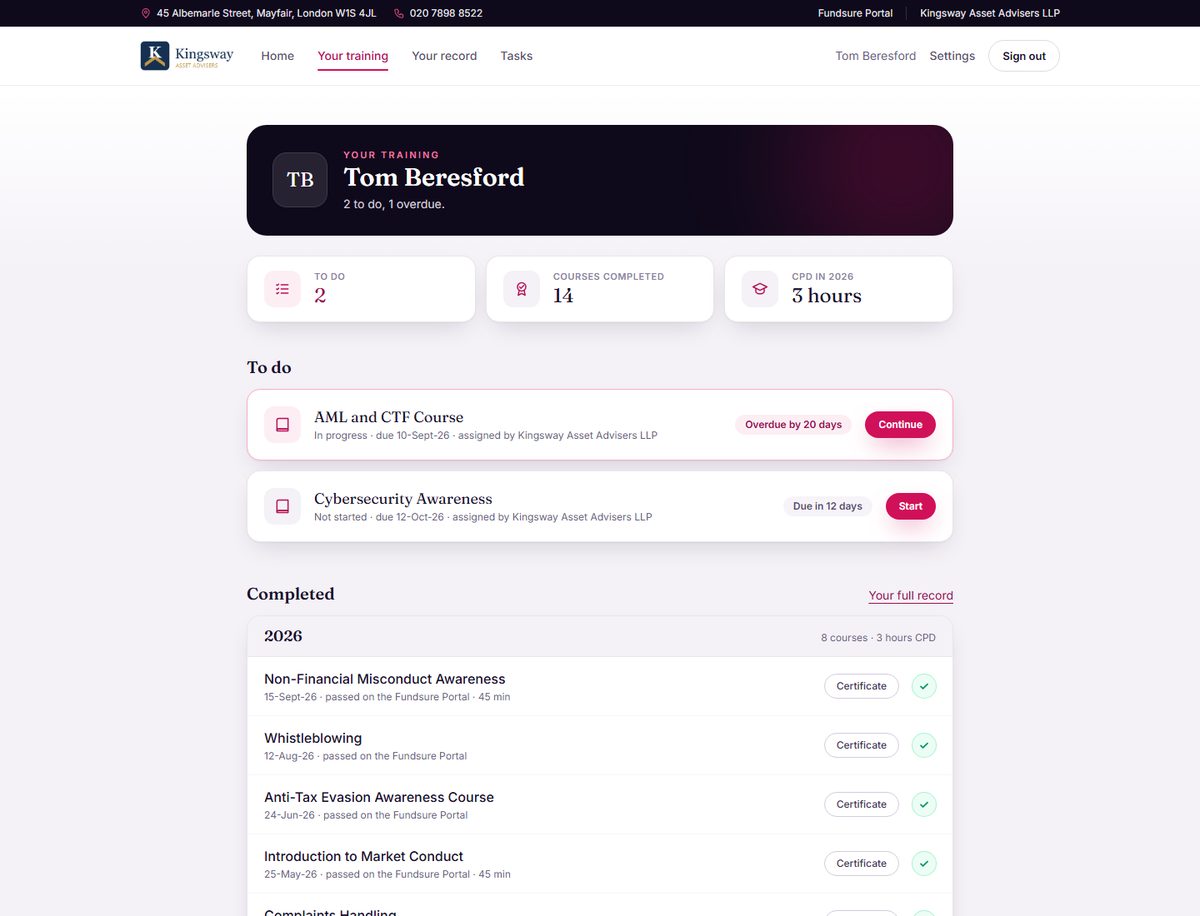
What each member of staff sees: their courses, their deadlines and their CPD for the year.
Training is available on its own or as part of the Fundsure Portal, where it sits alongside compliance monitoring, attestations and the rest of your compliance programme.
See the Fundsure PortalFor FCA Annex 1 firms and other MLR-registered businesses that only need the annual anti-money laundering training. The same CPD-assessed course, run for you in the portal, with the full catalogue there whenever you want it.
A 10-person firm running AML, Conduct Rules, Market Abuse, Anti-Bribery and Cyber each year would typically pay £36 to £60 per course per person elsewhere, around £2,500 a year. With Fundsure it is £1,200 plus VAT, and every other course is included.
How compliance training costs compareEvery course in the catalogue, as many as each person needs. No per-course fees.
We will send you a link to work through any course and see a sample certificate, or walk you through the portal with a demonstration firm.